


An employee can be in every meeting, answer every message, and still be quietly struggling. That is why the importance of mental health in the workplace belongs in the center of every 2026 workforce strategy.
Mental health at work affects how people perform, whether they stay, how often they need leave, and how much avoidable cost shows up elsewhere in the business.
In Spring Health's 2026 Workplace Mental Health Annual Report, 95% of HR professionals said workplace mental health is somewhat or very important to their company's business strategy in 2026. In this blog post, we examine why it’s so important and what organizations can do to best support employees.
What is the importance of mental health in the workplace?
When employees have timely, trusted support, they are more likely to stay engaged, seek care earlier, and recover before distress becomes absence, leave, or higher-cost care.
A mentally healthy workplace does not mean every employee is stress-free. It means the organization reduces preventable risks, gives people credible ways to get support, and measures whether that support is working.
Why workplace mental health matters now
Employee mental health shapes the daily capacity of a workforce. It affects focus, energy, communication, decision-making, manager effectiveness, leaves of absence, healthcare utilization, and retention. The World Health Organization reports that depression and anxiety account for an estimated 12 billion lost working days each year, costing the global economy about $1 trillion annually in lost productivity.
The pressure is not isolated to a small segment of workers. Gallup's 2026 State of the Global Workplace 2026 Report found that only 20% of employees globally were engaged at work in 2025, while 40% experienced significant daily stress. Gallup also estimated that low engagement cost the world economy approximately $10 trillion in lost productivity in 2025.
For HR and benefits leaders, those numbers make the point clear: Employee mental health is a business issue because work depends on attention, judgment, cooperation, and energy. When those are depleted, the organization feels it in missed work, slower work, avoidable conflict, higher claims, and preventable turnover.
The financial angle: Untreated needs show up as cost
Spring Health's 2026 research found that 89% of HR leaders believe mental health benefits create a competitive advantage, but only 9% say their solution is clearly reducing health plan spend. That disconnect matters when finance teams ask HR to defend every dollar.
The right business case should connect mental health at work to measurable cost categories:
- Health plan spend, including medical and pharmacy claims.
- Absenteeism and presenteeism, especially when employees are working while exhausted, distracted, or emotionally depleted.
- Disability and leave of absence claims.
- Turnover costs, including recruiting, onboarding, and lost institutional knowledge.
- Manager time spent responding to avoidable escalations without the right support.
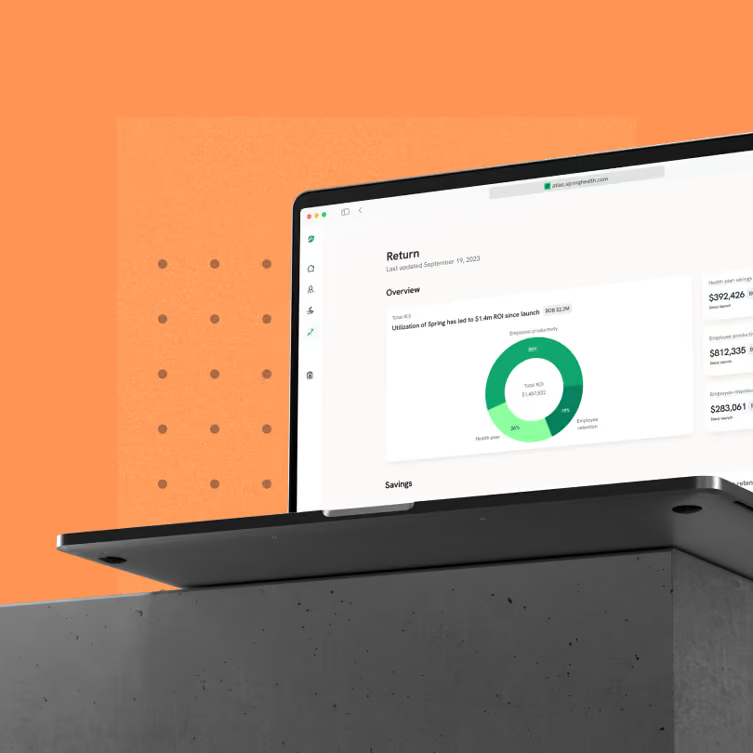
Spring Health's own approved outcomes make that business case tangible. Employers using Spring Health see a 52 percent reduction in total mental health claims costs for employers, and Spring Health is the first mental health solution to guarantee net ROI, with every single customer achieving it.
The productivity angle: The risk is often quiet before it is visible
The current post correctly names productivity, but it does not go far enough. The 2026 risk is not only the employee who misses work. It is also the employee who keeps showing up while mentally checked out, exhausted, sleeping poorly, or unable to focus.
Spring Health's 2026 report announcement found that 40% of burned-out employees report being physically present but mentally checked out at work. The same research found sleep issues were the top mental health challenge employees reported, cited by 36% of employees.
That is what makes mental health at work hard to manage. Many warning signs are not dramatic. They look like slower response times, more rework, withdrawal from team conversations, missed context, lower creativity, or a manager who keeps absorbing emotional strain without support.
Productivity improves when employees can get the right care early, before symptoms become more disruptive. That requires more than a list of resources. It requires fast access, clear pathways, manager awareness, and a system that can measure outcomes.
The retention angle: Mental health benefits shape job decisions
Employee mental health is now part of the talent equation. Spring Health's 2026 research found that 69% of employees say mental health benefits are very or extremely important when deciding whether to accept or remain at a job. Among employees ages 18 to 34, that figure rises to 83%.
That does not mean employees stay because a benefit exists on paper. They stay when the benefit feels real: easy to understand, easy to access, trusted, confidential, and useful when life or work becomes hard.
The retention case is also a credibility case. If an employer says mental health matters but employees cannot find a provider, understand their coverage, or get time to use the benefit, the promise weakens. Over time, that credibility gap can become a talent risk.
The leave and disability angle: Late-stage support costs more
Mental health leaves rarely begin when paperwork starts. By then, employees may have spent weeks or months trying to keep working through escalating strain. Spring Health research found that 61% of HR and benefits professionals reported an increase in mental health leaves of absence over the past year.
That makes leaves a late-stage signal of unmet needs. Employers need a mental health strategy that reaches people before they hit the point of absence, disability, or crisis. The goal is to reduce avoidable escalation by making effective support easier to reach earlier.
What employers can do to support employee mental health
Employers cannot remove every source of stress from work or life. They can build a workplace where risks are easier to see, care is easier to access, and leaders know how to connect people to support without trying to diagnose or treat them.
1. Measure the right mental health at work signals
Start with the signals that show whether the workforce is getting help early enough. Utilization alone is not enough because a program can be used often and still fail to improve outcomes.
- Track utilization, time to first appointment, engagement by population, and repeat engagement.
- Monitor absenteeism, presenteeism signals, disability claims, leaves of absence, and turnover trends.
- Review health plan spend and pharmacy trends where appropriate.
- Ask whether employees know what support is available and whether they trust it.
2. Remove the barriers that keep employees from care
Spring Health's 2026 research found that employees still face practical barriers to care: lack of time, cost concerns, difficulty finding the right provider, wait times, and stigma. Employers should make the path to care shorter, clearer, and more flexible.
- Explain cost coverage in plain language, more than once per year.
- Communicate benefits in the channels employees already use, including Slack, email, intranet, manager conversations, and onboarding.
- Offer virtual and in-person options when possible.
- Reduce steps between deciding to seek care and booking the first appointment.
- Make support available for dependents and life moments beyond work stress.
3. Equip managers to be bridges, not clinicians
Managers often see changes first: withdrawal, missed deadlines, conflict, fatigue, or sudden performance shifts. They should not diagnose employees or act as therapists. They should know how to notice changes, respond with care, and point employees to appropriate resources.
- Train managers on how to recognize common signs of distress and burnout.
- Give managers simple language for checking in without prying.
- Clarify escalation pathways for urgent concerns.
- Teach managers how workload, role clarity, autonomy, and psychological safety affect mental health at work.
4. Treat access as a clinical and business requirement
Long wait times make employee mental health needs harder and more expensive to address. Spring Health members schedule appointments in less than two days on average, compared with a 48-day average with traditional EAPs. Faster access helps employees start care before stress becomes a larger clinical or operational issue.
Access should include the right match, not only any appointment. Employees need care that fits their needs, preferences, language, schedule, and level of acuity.
5. Build a culture where using care feels safe
The American Psychological Association's Work in America research found that employees who reported a toxic workplace were more than twice as likely to report fair or poor mental health than those who did not report a toxic workplace. The same research connected toxic workplaces with turnover risk and harm to mental health at work.
Culture changes when employees see consistent signals that care is acceptable, confidential, and supported. Leaders can normalize mental health care by speaking accurately, sharing resources before problems escalate, protecting time to use benefits, and treating accommodations and leave with respect.
6. Evaluate mental health vendors on outcomes, not promises
A modern mental health benefit should be able to show whether employees are getting better and whether the organization is seeing measurable value. When evaluating a partner, employers should ask:
- How quickly can employees get an appointment?
- How are employees matched to the right level and type of care?
- How are clinical outcomes measured?
- Can the platform show financial outcomes, not just utilization?
- How does the model support employees across life stages, locations, providers, and needs?
Spring Health reports that 92% of members reliably improved or recovered from depression or anxiety, and members recover 5.9 weeks faster than our leading competitor. Those outcomes matter because employer-facing mental health benefits should improve care and make the business case visible.
What happens when mental health at work is supported well
When employers support mental health well, the impact reaches beyond any single benefit. Employees can seek support earlier. Managers have clearer pathways. HR has stronger data. Finance has a more credible cost story. Leaders can connect care, culture, and business performance without reducing mental health to a productivity tool.
The strongest workplace mental health strategies do three things at once:
- They reduce barriers to care.
- They improve measurable outcomes.
- They make the value of support visible to the business.
About Spring Health
Spring Health is a global mental health company built on one AI-native platform so care follows individuals across every job, move, health plan, and life stage. Independently validated by JAMA Network Open and the Validation Institute, Spring Health reaches 170+ million people worldwide through leading employers and health plans.
FAQ
Why is mental health important in the workplace?
Mental health is important in the workplace because it affects how employees focus, communicate, perform, stay engaged, and remain with an organization. Poor mental health support can contribute to absenteeism, presenteeism, leave, higher healthcare costs, and turnover.
How does employee mental health affect productivity?
Employee mental health affects productivity by influencing concentration, energy, decision-making, collaboration, and attendance. Employees may continue working while emotionally drained or mentally checked out, which can reduce output before the issue becomes visible as absence or leave.
What can employers do to improve mental health at work?
Employers can improve mental health at work by reducing access barriers, communicating benefits clearly, training managers, measuring outcomes, supporting psychological safety, and choosing mental health care that helps employees reach the right support quickly.




.png)


.avif)
.avif)


.avif)

.avif)
.avif)
